Heterochone calyx
Schrammen 1912
Heterochone calyx is a very rare species reported from Oberg (near Ilsede) by Schrammen (1912) as "Chonelasma hindei". It is reported here from Höver for the first time.
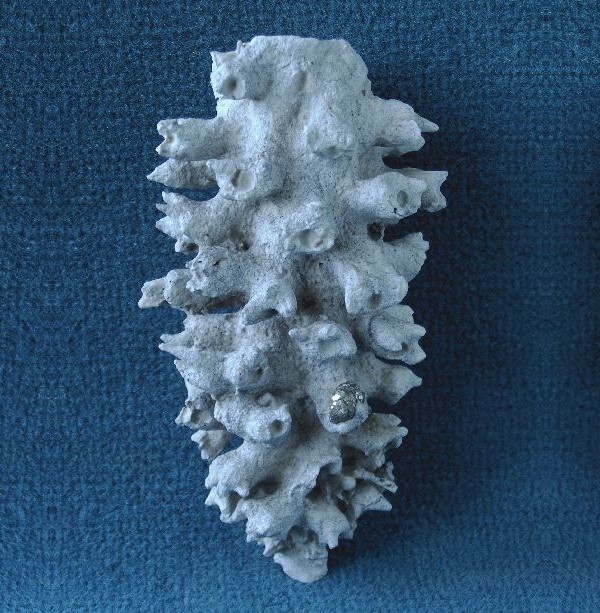
The specimen of Heterochone calyx consists of an axial tube (or narrow funnel) with a compact stalk (10 mm thick) and with numerous radially directed, finger-like protrusions (8 to 15 mm diameter, 10 to 25 mm long) in the calyx section. The protrusions show a vague spiralling arrangement. They have 3 to 5 mm wide parietal oscula at their truncated ends, but each protrusion has some conical appendices surrounding the accessory oscula.
The wall thickness of the specimen is slightly more than one mm. Ostia and postica cannot be discerned in the unetched specimen, but are reported in the literature (Reiswig, 2002).
The dictynal skeleton is quite irregular, with many triangular meshes. The hexactines show spherically enlarged nodes.
Heterochone punctata
Schrammen 1912
Heterochone punctata is another very rare species from Oberg, described by Schrammen (1912) as "Chonelasma punctata". It is reported here from Höver for the first time.
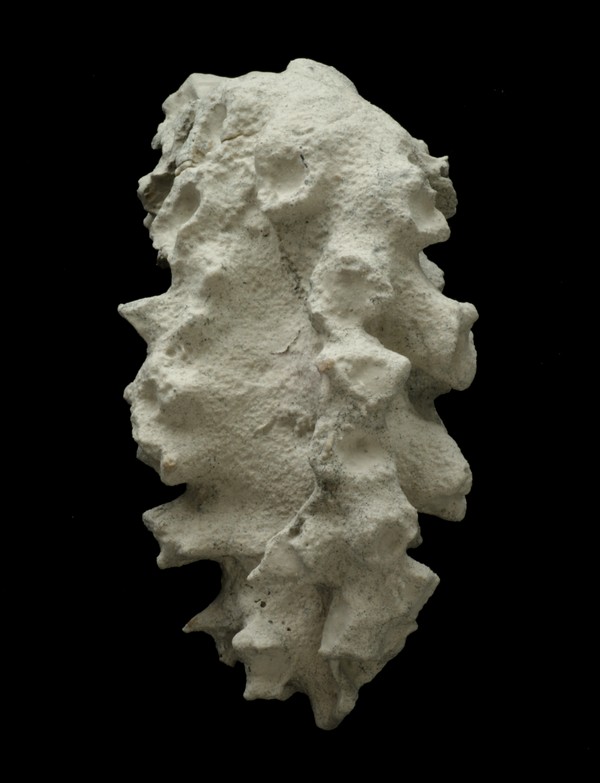
The specimen of Heterochone punctata consists of a longitudinally plicated axial tube. The areas between the folds are flat, while the folds are further subdivided into a number of short side tubes or accesory oscula, approximately 8 mm in diameter. The terminations of the side tubes are modified as described in the case of Heterochone calyx by several conical appendices surrounding the accessory oscula.
The wall thickness of the specimen is slightly more than one mm. In the case of Heterochone punctata ostia may be discerned even in the unetched specimen and give rise to the species name.